What’s the approximate value of your investable retirement assets?
401(k), IRA, Roth, brokerage, cash. Not including your home or other real estate.
And what’s your approximate real estate value?
Total value of your home and any other property you own. Used separately to model your probate exposure.
Is your investment portfolio specifically designed for the distribution phase — or is it still structured for accumulation?
How are your essential monthly living expenses covered in retirement?
Do you have a specific, written withdrawal sequence — which accounts get drawn first, second, third — modeled across multiple tax years?
Are you currently subject to Required Minimum Distributions (RMDs) — or will you be within the next 5 years?
Has your retirement plan been formally stress-tested against the conditions that actually break plans — a 40% market drop in year 2, the death of a spouse, sustained inflation, or living past 90?
Do you have a revocable living trust that is properly funded and has been reviewed in the last 2 years?
What is your current plan to cover potential long-term care costs (nursing home, assisted living, home care)?
Have your financial advisor, estate attorney, and CPA coordinated directly on your retirement plan in the last 12 months?
DuPont Law Group · Advocate Wealth Solutions
PILOT Process Scorecard™ — Personalized Results Report ·
Your plan has critical vulnerabilities.
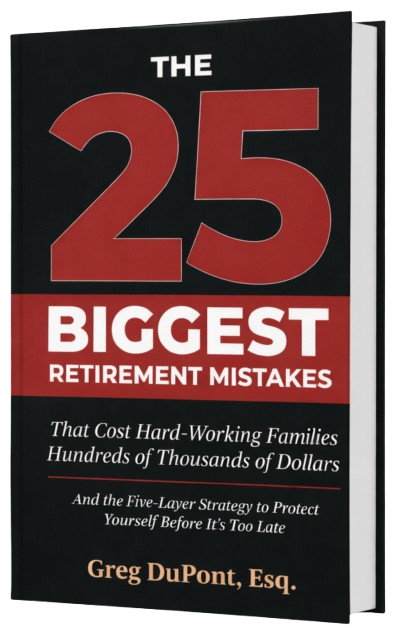
Your free copy is ready.
Download The 25 Biggest Retirement Mistakes by Greg DuPont, Esq. — the complete guide to protecting your retirement from the five risks that quietly drain family wealth.
↓ Download Free Book (PDF)
Gregory S. DuPont, Esq., CFP®
Estate Planning Attorney · Certified Financial Planner®
One of fewer than 3,000 Americans who hold both credentials.
Greg has spent over 30 years as a licensed estate planning attorney and CFP® professional, planning through three estate tax overhauls, four market crashes, and a full generational cycle of clients whose plans have already played out. He’s the founder of DuPont Law Group, Advocate Wealth Solutions, and the creator of the PILOT Process and the March to a Million™ movement — on a mission to help one million American families save a collective one billion dollars.
The next step is a real conversation.
Not a sales meeting. A comprehensive retirement planning assessment that looks at your specific situation across all five PILOT layers. Greg’s team will tell you honestly where your plan is strong, where it has gaps, and what it would take to close them — before the window closes.
Questions? Call (614) 881-2523 or email [email protected]
Based on published research from Vanguard, Genworth Financial, the American Association of Retired Persons, the American Bar Association, the Financial Planning Association Journal, the National Bureau of Economic Research, the Internal Revenue Service, and the Department of Health and Human Services. Individual results vary.
| Statistic used | Source |
|---|---|
| A 30% drop in year one of retirement can permanently reduce lifetime income by 40%. | Vanguard Research |
| Sequence-of-returns risk is the number-one destroyer of retirement plans. | Vanguard Research |
| Retirees with a written income plan are 2.5× more likely to feel financially confident and significantly less likely to run out of money. | Financial Planning Association |
| A multi-year tax strategy saves $120,000 to $160,000 in lifetime taxes on a $1.4 million retirement account. | Financial Planning Association Journal |
| 96% of retirees claim Social Security at the wrong time, costing the average household $111,000 in lifetime benefits. | United Income (2019) |
| Sequence-of-returns risk, inflation, and unexpected health costs are the three most common causes of retirement-plan failure. | National Bureau of Economic Research |
| Probate costs 5–10% of the gross estate value, with attorney fees reaching 20% or more in contested cases. | American Bar Association |
| Private nursing-home care costs $127,750 per year. | Genworth Financial 2024 Cost-of-Care Survey |
| 70% of people age 65 or older will need some form of long-term care. | U.S. Department of Health & Human Services |
| Retirees without a guaranteed income floor are 3× more likely to run short of money. | PILOT Process modeling, based on published longevity & sequence-of-returns research |
These figures inform the PILOT Process Scorecard methodology and the dollar-exposure model used above. Individual results vary based on tax law, market conditions, health, age, and specific account structure. This Scorecard is an educational tool, not legal, tax, financial, or investment advice.